A forested ridge with exposed gray rock outcrops along its crest, with rolling tree-covered hills receding into haze under a pale blue sky.Hand it off

Signs of a bad AC capacitor in Arkansas

Once you send the form, finding a pro is off your list.

Your AC is running almost nonstop trying to keep up with the heat outside, and that hum you hear is the capacitor giving the compressor and fan motor the jolt they need to start and keep turning. When it starts to fail, the signs show up fast. The unit might hum but the fan won't spin. It might click and try to start every few minutes. The air coming out might be warm, or weaker than it should be, on a day when you need it most. Sometimes the outside unit just goes quiet.

A bad capacitor doesn't fix itself, and in an Arkansas summer, a day or two without cooling is more than an inconvenience. Humidity builds up inside the house fast once the air stops moving. The compressor can also take damage trying to start without the capacitor's help, which turns a small, cheap part into a bigger repair if it sits too long.

You don't have to spend the afternoon calling around to find out who's available, explaining the same symptoms to three different shops, and comparing quotes before you even get someone on the schedule. That part of this is work nobody wants to do when their house is already warm and getting warmer.

Send the details once through the form below. From there, finding a licensed contractor to check the capacitor and get your system running again isn't something you have to manage yourself. That part is off your plate the moment you hit submit, and someone will be in touch to sort out the rest.

What are the signs of a bad AC capacitor?

Your AC has been running long hours trying to keep up with the heat, and now something feels off. Maybe it hums but the fan doesn't spin, or it clicks and shuts off before the air gets cold. You want to know if this is the capacitor before you decide what to do next, especially with Arkansas summers giving the unit no real break.

A bad capacitor shows up as a humming unit that won't start, or one that shuts off on its own

A failing capacitor often means the outdoor unit hums but the fan blade doesn't move, or the compressor tries to start and trips off again. Some units need a push to start, the fan only spinning if you nudge it by hand. Others cycle on and off every few minutes instead of running a full cycle. The capacitor stores the charge that gets the compressor and fan motor moving, and once it weakens, that jolt isn't enough. With an Arkansas summer putting long hours on the unit, a weak capacitor gets pushed past the point of starting at all, and the house stops cooling right when you need it most.

  1. The thermostat calls for cooling and sends power to the unit.

  2. The capacitor stores a charge and releases it to the motors.

  3. That jolt starts the compressor and the fan motor turning.

  4. A weak capacitor can't hold enough charge to start them.

A gray outdoor air conditioning condenser unit on a concrete pad beside a house with horizontal siding and a stone veneer base, with refrigerant line and electrical disconnect box on the wall and flowering shrubs to the left.
The condenser hums and starts right up, and cold air keeps coming even on the hottest afternoon.
An outdoor air conditioner condenser unit on a concrete pad beside a house with light gray horizontal siding, with mulch and green shrubs on either side and a concrete walkway in the foreground.
Dirt-caked fins and a weathered case like this often sit over a capacitor too weak to start the compressor.

Is your AC struggling to keep your house cool?

You might notice the air taking longer to feel cold, or the thermostat holding at 78 when you set it for 72. The outdoor unit may click a few times before it starts, or hum for a few seconds and then quit. Some afternoons it shuts off on its own and the house starts warming back up within the hour. With a muggy Arkansas summer outside, a unit that can't start or hold a cycle means your house gains heat and humidity faster than it loses it, and the compressor working against a weak capacitor can wear out sooner than it should.

A gray outdoor air conditioner condenser unit on a concrete pad beside a house with horizontal vinyl siding, surrounded by mulch, flowering shrubs, and lawn.

Running clean

This condenser starts as soon as the thermostat calls, then settles into a steady hum. The fan spins right away and stays on until the house reaches temperature. Mulch and grass around it stay clear of the cabinet, and nothing rattles when it cycles on.

A weathered outdoor air conditioning condenser unit on a concrete pad beside a house with light horizontal siding, an electrical disconnect box and conduit on the wall, and mulched soil on either side.

Running down

Grime like this across the fins makes the unit work harder to pull heat off the coil, and a capacitor under that extra strain wears out sooner. If yours looks like this and the fan hesitates or the unit clicks before starting, the capacitor may already be close to done.

A smiling man in a dark navy sweater sits on a light sofa in a living room, with a glass bowl of popcorn on a wooden coffee table and bookshelves behind him.
A smiling man in a dark green sweater sits on a tan leather sofa in a dimly lit living room, with a bowl of popcorn in the foreground and a kitchen area blurred behind him.
A smiling middle-aged man in a dark shirt sits on a gray sofa in a living room, with a bowl of popcorn on a side table and shelves, a window and kitchen area behind him.
A smiling bearded man in a dark gray t-shirt sits on a gray couch in a living room, with a large glass bowl of popcorn on a wooden table in the foreground.

Hand off the air conditioner problem

Fill out one short form instead of calling around.

It costs nothing to send, and you don't have to hire anyone.

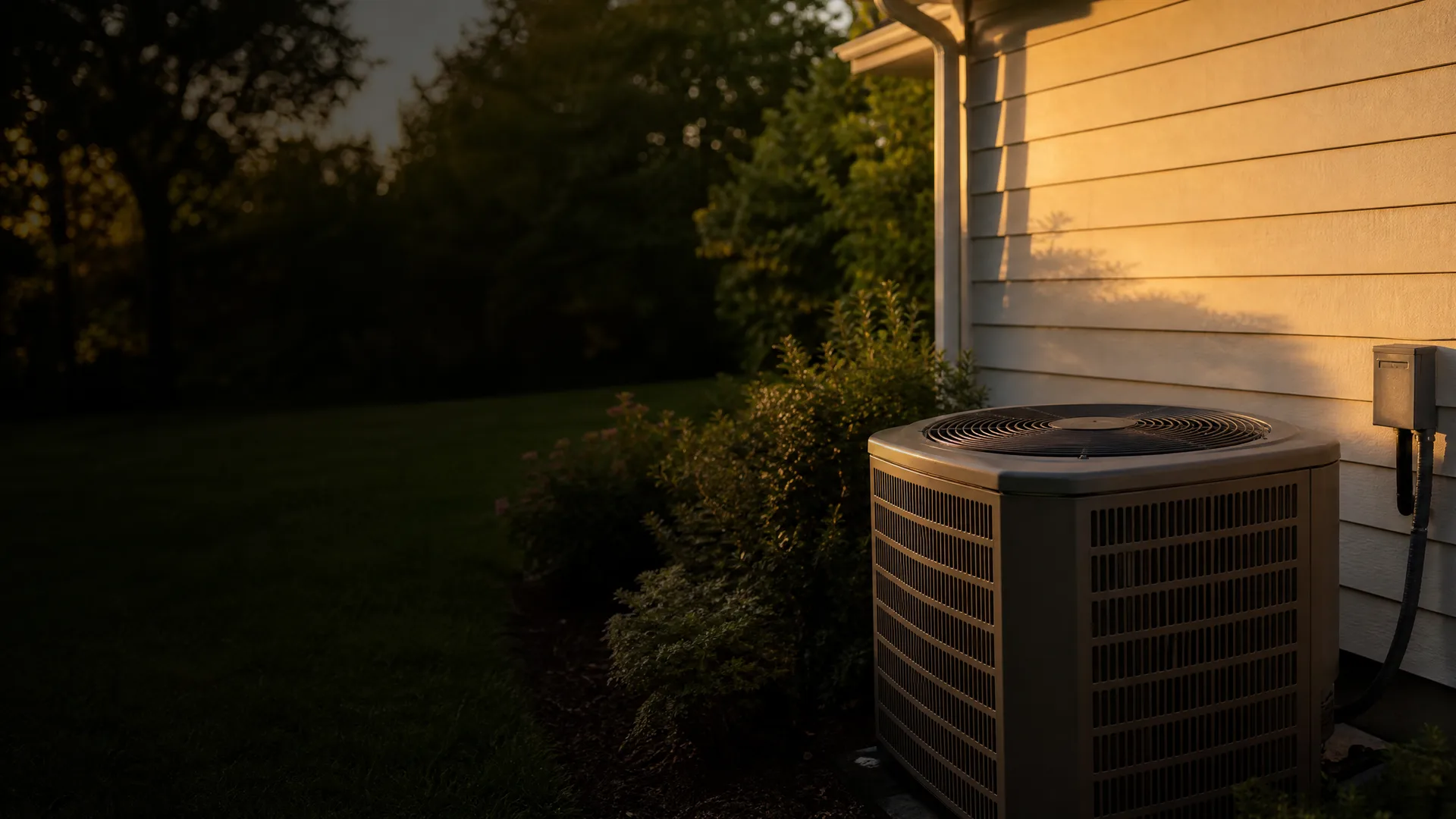
An outdoor air conditioner condenser unit beside a light-colored lap-sided house with an electrical disconnect box on the wall, surrounded by shrubs and lawn in low evening light.

By seven that evening the sun was finally dropping behind the fence line, the kind of gold light that makes the yard look cooler than it is. It wasn't. You walked out past the grill to check on the unit because the house still hadn't dropped below 78. The condenser sat there humming low, same as it had for the last twenty minutes, but the fan on top wasn't moving. No blades turning, no air pushing out the top grille. Just that steady electrical hum and the heat sitting on your skin, thick the way August evenings get here. You crouched down and listened closer, half expecting it to kick in like it always had. It didn't.


A closed laptop and a cream mug of coffee on a coaster sit on a dark wooden table, with a potted plant at left and a kitchen counter, tiled backsplash and shelf of ceramics in the background.

What a bad capacitor costs you in your own house

A failing capacitor in July doesn't wait for a convenient night. It usually gives out on the hottest afternoon, when the compressor is working hardest and asking the most of it. If yours quits then, you're not just uncomfortable. You're watching the thermostat hold at 78 while the house soaks up heat, and a compressor that keeps trying to start without enough charge can burn itself out, turning a small part into a much bigger repair.

This is also where most people lose an evening they didn't plan to lose: searching for a contractor who answers the phone on a weekend, calling two or three more when the first one can't come for days, explaining the hum and the clicking and the 78 on the thermostat each time you call. Send the form once and that search is off your plate. You're not diagnosing anyone's schedule or comparing quotes at nine at night. You're just waiting on the person who's coming to fix it.

A gray upholstered sofa with a textured cushion sits beside a dark round side table holding a vase of green foliage, with a table lamp and sheer-curtained window behind.
A gray outdoor air conditioner condenser unit on a concrete pad beside a house with horizontal lap siding, with a wall-mounted disconnect box and conduit to its right and shrubs to the left.

Working as it should

The condenser sits on its pad, conduit running to the disconnect box, and it starts the moment the thermostat calls. The fan spins right up, the hum stays steady, and cold air follows within minutes. Nothing about it asks for your attention.

An outdoor air conditioning condenser unit on a concrete pad beside a house with horizontal lap siding, with a conduit and electrical disconnect box on the wall at right.

A capacitor giving out

The coil guard is caked with dirt and the cabinet shows its age, the kind of unit that hums for a few seconds then clicks off before the compressor catches. Grime alone won't stop a capacitor, but a unit left dirty this long often has a weak one underneath.

Power costs 12.87 cents per kilowatt-hour statewide

At 12.87 cents per kilowatt-hour, running your AC flat out while a weak capacitor struggles to start the compressor adds up fast. The motor draws extra current trying to start on a failing charge, and you pay for that effort whether the air ever gets cold or not.

EIA-861 2025 statewide residential average

What the capacitor actually does

The capacitor holds a charge and releases it in one burst to get the compressor and fan motor turning. A motor can't start itself from a dead stop. It needs that push, and only the capacitor delivers it. Once the motor is spinning, it keeps going on its own, which is why a weak capacitor often shows up as a hum or a click rather than total silence. The push just isn't strong enough anymore to get the motor past that first turn, even though the unit still has power and still wants to run.

Why it wears down over time

A capacitor loses strength with heat and age, not all at once but a little each summer. Arkansas summers push it harder than a mild climate would, since the compressor cycles on for long stretches trying to keep up. Every start draws on the capacitor's charge, and over enough hot afternoons the part simply can't hold what it used to. By the time you notice clicking or a slow start, it's usually been weakening for a while. It rarely fails on a cool, easy day. It fails when the unit is working hardest.

A woman with dark hair in a bun reclines on a sofa with her eyes closed, wrapped in a cream fleece blanket, a closed blue hardcover book resting in front of her, with a lit lamp and a vase of dried flowers in the background.
A smiling bearded man in a navy sweater sits at a candlelit dinner table with a glass of red wine, a bowl of salad, and plates of food in the foreground.
A single-story red brick ranch house with white-framed windows and a white storm door, fronted by a large asphalt parking area and backed by leafy green trees under a bright hazy sky.

Arkansas summers run a dew point near 68°F in June, July and August, averaged across where people live in the state, according to NOAA climate data. That's heavy, damp air, the kind that sits on your skin the second you step outside. Your AC isn't just dropping the temperature in that air, it's wringing the moisture out of it too, which asks more of the compressor on every single cycle. A capacitor that's already weak has less margin to work with when the air is this thick. You'll notice it as longer run times, a house that feels cool but still clammy, or a unit that hums like it's straining before it finally kicks on.

NASA POWER T2MDEW county cells weighted by homes

A bad capacitor shows itself in a few clear ways: humming with no fan movement, clicking that won't catch, a slow climb to cold air, or a unit that shuts off before the house ever reaches temperature. If you're seeing any of that, the capacitor is the likely reason, and it only gets worse from here, usually at the worst possible time. What it doesn't have to involve is you spending the next few days calling around, explaining the same hum and click to three different shops, and sitting with quotes trying to guess who's worth trusting. You already know what your unit is doing. You don't need to spend your evening finding out who can look at it. Send the form once and that search is off your plate, handed to a licensed contractor near you instead of sitting on your list between everything else this house needs tonight.

An outdoor air conditioner condenser unit sits on a concrete pad beside a house with horizontal siding and stone veneer, next to mulch, shrubs, and grass.

Send one request and you're done looking

Step 1 of 3: Equipment